CSS in 2026: The New Features Reshaping Frontend Development
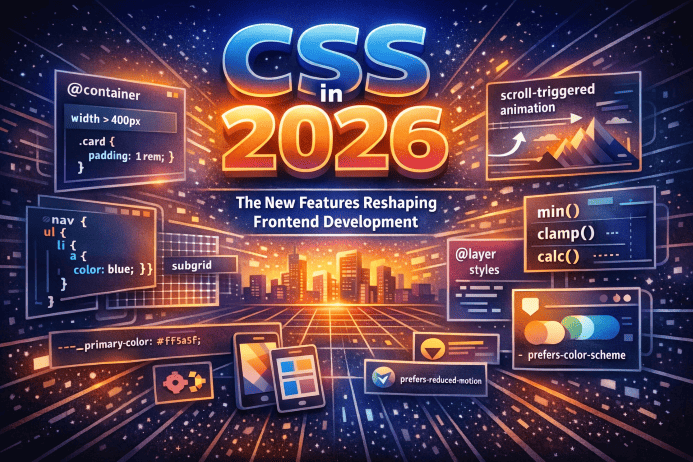
CSS has evolved dramatically in recent years, and 2026 marks a moment where frontend development becomes more powerful, more flexible, and closer to the capabilities of a modern programming language. From container queries to native nesting, from logical functions to advanced variables, CSS is no longer just a styling language — it is a mature ecosystem capable of solving problems that once required JavaScript or heavy frameworks.
In this article, we explore the most important CSS features shaping frontend development in 2026 and how they change the way we build interfaces.
1. Container Queries: truly modular design
Container Queries are arguably the most important CSS innovation of the last decade. Instead of relying on the size of the entire page, components can now react to the size of their own container. This means design becomes truly modular, predictable, and easy to reuse.
In 2026, support is complete across all modern browsers, and UI frameworks have begun dropping hacks and complex media-query systems.
2. CSS Nesting: cleaner code without preprocessors
Native nesting eliminates the need for Sass or Less for hierarchical structures. Code becomes shorter, clearer, and easier to maintain. In 2026, nesting is standard and widely adopted in new projects.
3. Subgrid: full control over layout
Subgrid solves one of CSS Grid’s most frustrating limitations: aligning elements inside nested grids. Components can now inherit the parent grid’s lines, enabling complex but perfectly aligned layouts.
In 2026, subgrid is heavily used in design systems and enterprise-level layouts.
4. Advanced CSS variables and new functions
CSS variables have become more powerful, and modern functions like min(), max(), clamp(), and calc() are used in almost every project. In 2026, CSS offers a level of mathematical control that previously required JavaScript.
The result: fluid, responsive designs without unnecessary media queries.
5. Scroll-driven animations: animations without JavaScript
CSS Scroll-Driven Animations allow developers to create animations synchronized with scrolling — no JavaScript required. Effects like parallax, fade-in, slide, or complex transforms are now native, performant, and easy to control.
In 2026, these animations are standard in storytelling websites, landing pages, and interactive interfaces.
6. CSS Layers: control over style priority
CSS Layers solve style conflicts through a clear priority system, similar to how z-index works for elements. Frameworks, libraries, and custom styles can coexist without unwanted overrides.
In 2026, most design systems use @layer to organize styles cleanly.
7. Modern media queries: preferences, accessibility, and new devices
CSS has become smarter about accessibility and user preferences. In 2026, media queries such as:
prefers-reduced-motionprefers-contrastprefers-color-schemedynamic-range
are essential for personalized, accessible, and standards-compliant experiences.
8. Conclusion: CSS becomes a complete language
CSS in 2026 is no longer just a styling language. It is a powerful, modular, predictable tool capable of handling complex layouts, advanced animations, and fluid design systems without external dependencies.
Modern frontend development relies increasingly on native CSS capabilities, and developers who embrace these features early will have a major advantage in future projects.





Be the first to comment!