Technology in 2026 – AI‑Native, Autonomous Agents and Intelligent Infrastructures
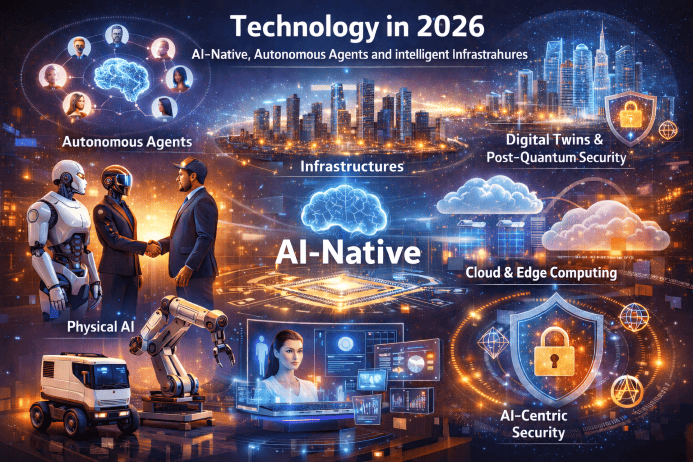
2026 marks a turning point in technology. Artificial intelligence is no longer an additional tool, but the foundation on which modern applications are built. From autonomous agents collaborating with each other to intelligent infrastructures and post‑quantum security, this year reshapes the way we think about software, business, and innovation.
1. AI‑Native Development – Applications Built with AI in Their DNA
In 2026, applications no longer “use” AI — they are designed around it. AI‑native becomes the new standard in development, and software learns, optimizes, and adapts in real time.
What AI‑native means in practice:
- Applications automatically adjust their performance and interface
- Code generated, verified, and optimized by AI agents
- Fully automated backend workflows
- Real‑time data‑driven decisions without human intervention
2. Multi‑Agent Systems – AI Collaborating with AI
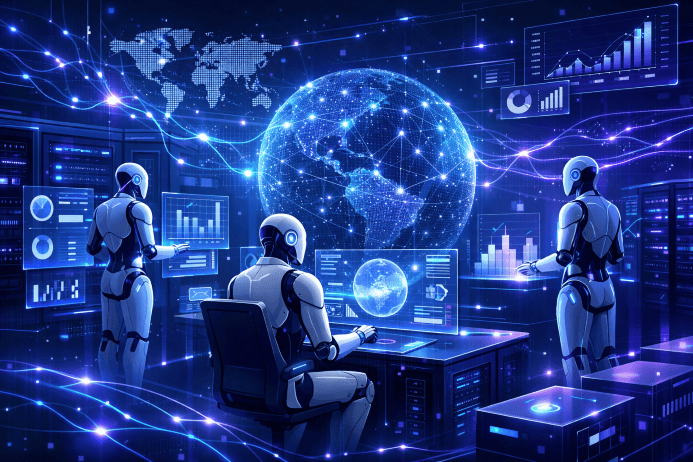
Large language models are gradually replaced by ecosystems of specialized agents. Each agent has a role, and together they form an autonomous system capable of managing complex projects.
Clear advantages:
- Complete automation of repetitive processes
- Collaboration between agents for complex tasks
- Reduced software development time
- Scalability without major additional costs
3. Physical AI – When Artificial Intelligence Becomes Physical
AI steps out of the screen and into the real world. Smart devices, autonomous robots, and AI‑assisted physical systems become part of everyday life.
Examples from 2026:
- Fully autonomous delivery robots
- Home devices that learn user behavior
- AI‑assisted robotic arms in manufacturing
- Intelligent urban monitoring systems
4. AI Eliminating Repetitive Work
Companies massively adopt AI to eliminate manual tasks. From document processing to customer support, AI takes over everything repetitive, leaving humans with creative and strategic roles.
Where the change is most visible:
- Back‑office and operations
- Financial analysis and reporting
- Technical support and customer service
- Project management
5. Security: Confidential Computing and AI‑Centric Protection
As AI becomes infrastructure, security becomes critical. Confidential Computing and AI‑assisted security platforms are the standard of 2026.
Major benefits:
- Data protection during processing
- Automatic detection of cyberattacks
- Fast incident response through AI agents
- Advanced encryption for distributed ecosystems
6. Cloud + Edge – The Intelligent Infrastructure
Cloud and edge computing merge into a unified architecture. Devices become smarter, and applications faster and more efficient.
What this integration brings:
- Local processing for minimal latency
- Applications that work even without internet
- Automatic scaling based on traffic
- Much more reliable industrial IoT
7. Digital Twins and Post‑Quantum Security
Digital twins become essential tools in industry, and companies prepare for the post‑quantum era through encryption technologies resistant to advanced attacks.
Key trends:
- Digital simulations for factories, cities, and infrastructures
- Full control over data through digital sovereignty
- Cryptography prepared for quantum computers
- Real‑time predictive optimization
8. Conclusion
2026 is the year when technology becomes truly intelligent. AI‑native, autonomous agents, and hybrid infrastructures transform the way we build software, work, and innovate. It is not just an evolution — it is a paradigm shift. And those who understand these trends early will have a decisive advantage in the years to come.



Be the first to comment!