Cloud + Edge – the Intelligent Architecture of 2026
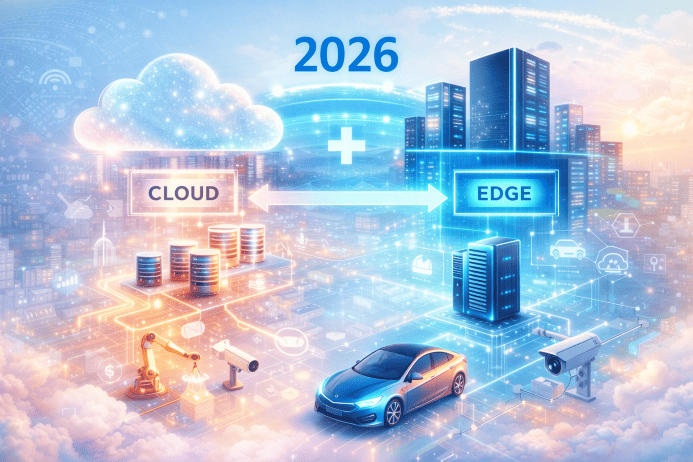
In 2026, companies no longer choose between cloud and edge computing. The two technologies merge into a smart hybrid architecture capable of delivering performance, security, and scalability simultaneously. This combination – Cloud + Edge – becomes the standard for modern applications, from industrial IoT to autonomous vehicles and real‑time AI systems.
1. What Cloud + Edge Architecture Means
Cloud + Edge is a model where data processing is split between:
- Cloud – for massive storage, advanced analytics, and complex AI models
- Edge – for fast, local processing close to the data source
The result is a flexible infrastructure capable of responding instantly to local events while benefiting from the cloud’s computing power for intensive workloads.
2. Why Cloud + Edge Becomes the Architecture of 2026
The explosion of smart devices and applications requiring ultra‑low latency has made cloud‑only processing insufficient. Edge computing solves this challenge, while the cloud provides scalability and intelligence.
Major advantages:
- Low latency – decisions are made locally in milliseconds
- Optimized costs – only relevant data is sent to the cloud
- Enhanced security – sensitive data can remain local
- Scalability – the cloud handles large volumes and complex AI models
- Resilience – edge systems work even with unstable connectivity
3. How Cloud + Edge Architecture Works
The architecture is built on an intelligent data flow:
Typical flow:
- IoT devices collect real‑time data
- Edge computing processes critical information locally
- The cloud receives only aggregated or historical data
- Cloud‑based AI models send back updates and optimizations
This creates a system that is both fast and intelligent.
4. Real Use Cases in 2026
Cloud + Edge architecture is already implemented in industries where speed and reliability are essential.
Representative applications:
- Autonomous vehicles – local decision‑making + global cloud analysis
- Smart factories – industrial sensors processing data at the edge
- Retail – real‑time inventory and customer analytics
- Smart cities – traffic, energy, and safety monitoring
- Healthcare – connected medical devices with local processing
5. Challenges and Limitations
Although powerful, Cloud + Edge architecture comes with technical and operational challenges.
Current limitations:
- High complexity in device orchestration
- Need for common standards across providers
- Initial costs for edge infrastructure
- Multi‑layer security management
6. Conclusion
Cloud + Edge becomes the intelligent architecture of 2026, offering the ideal balance between speed, security, and scalability. Companies adopting this model can build faster, safer, and more efficient applications, ready for a world where data is generated and processed in real time.


Be the first to comment!