HTML for Beginners – Quick Guide 2026
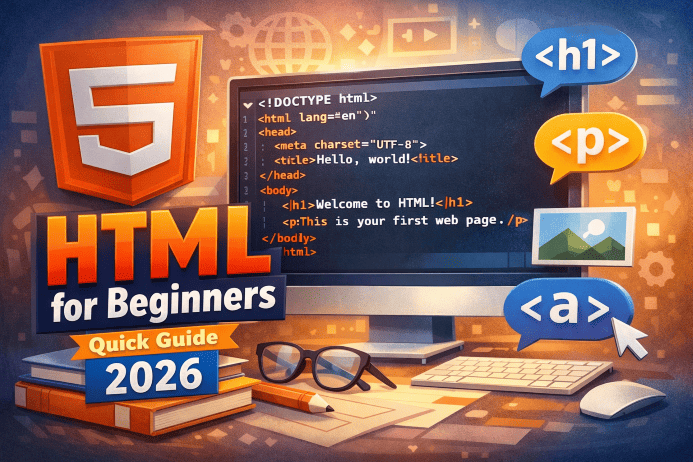
Every journey into the world of web development begins with HTML. It is the first language you learn and the foundation on which everything else is built: structure, design, functionality, and user experience. If you think of a website as a house, HTML is its framework – the essential structure without which nothing could exist.
This is why, even though technology evolves quickly and modern frameworks or advanced tools appear every year, HTML remains the starting point for anyone who wants to create something on the web. It is simple, logical, and beginner‑friendly, and once you understand it, everything else becomes much clearer.
For those who want to go deeper, IB‑Media offers a complete and free HTML course, ideal for beginners. You can access it here: Free HTML Course.
1. What HTML Really Is
HTML is a markup language, meaning a way to tell the browser how to organize and display the content of a page. You are not programming in the traditional sense; instead, you describe what each part of the page represents: a heading, a paragraph, an image, a list, or a section.
The browser reads these instructions and builds the page you see. It’s a simple process, but extremely powerful, because it allows you to create the structure of any website, from the simplest to the most complex.
<!DOCTYPE html>
<html>
  <head>
    <title>My first page</title>
  </head>

  <body>
    Welcome to HTML!
  </body>
</html>
2. What a Modern HTML Page Looks Like
Every HTML page is divided into two major areas: the invisible part, where technical information and page settings are stored, and the visible part, where the user sees the actual content. This structure is the same for any website, regardless of complexity.
The visible area contains everything that makes up a page: headings, text, images, buttons, menus, and sections. The invisible area contains things like the page title, mobile display settings, search engine information, and other important details.
<meta
  name="description"
  content="Your page description">

<meta
  name="viewport"
  content="width=device-width, initial-scale=1.0">
3. The Basic Elements You Need to Know
As a beginner, you don’t need to learn hundreds of elements. It’s enough to understand a few simple concepts:
- Headings – structure content from the main title to smaller subtitles.
- Paragraphs – the standard blocks of text.
- Links – allow navigation between pages or to other websites.
- Images – add visual content.
- Lists – useful for steps, ideas, or enumerations.
- Sections – divide the page into logical, easy‑to‑understand areas.
These elements are enough to create your first pages and understand how a website’s structure works.
<h1>This is a heading</h1>

<p>This is a paragraph of text.</p>

<a
  href="https://www.ib-media.com">
  Visit IB‑Media
</a><img
src="image.jpg"
alt="Image description">4. Why Semantic HTML Matters
As you learn more, you’ll discover that it’s not only important to display content, but also to organize it correctly. Semantic HTML means using the right elements for their intended purpose: a header for the top of the page, a main section for the central content, an article for an independent piece of text, or a footer for the closing information.
This helps with:
- a clearer page structure
- a better user experience
- improved understanding by search engines
- greater accessibility for people using screen readers
<header>Top area of the page</header>

<main>
  Main content
</main>

<footer>Footer information</footer>
5. Common Beginner Mistakes
It’s normal to make small mistakes at the beginning. The most common ones include:
- overusing generic elements instead of semantic ones
- creating pages without a clear structure
- ignoring mobile optimization
- using images without alternative descriptions
- mixing elements without a visual or logical purpose
6. Conclusion
HTML is the first step in web development and the foundation on which everything else is built. If you understand the structure of a page, the role of each element, and the importance of semantics, you will have a strong start in any direction you choose: design, front‑end, back‑end, or even complex application development. It is a simple, friendly language and the perfect way to begin your journey into the world of the web.

Be the first to comment!